How Many Italian Americans Are There?
The 2024 American Community Survey estimated 16,271,362 U.S. residents reporting Italian ancestry, or approximately 4.8% of the population. The estimate's margin of error is ±94,914. It includes people who reported Italian as their only ancestry and people who reported it alongside another ancestry. In everyday terms, that is about 16.3 million people. U.S. Census Bureau, 2024 ACS, Table B04006
These are survey estimates for 2024, released in 2025. As of this guide's October 1, 2026 update, the Census Bureau's latest posted update says the release date for the 2025 ACS one-year estimates is still being determined. The year in the statistic matters: an article updated in 2026 does not automatically contain a 2026 population count. Census release update
What the ancestry estimate measures
The ACS asks about ancestry or ethnic origin and codes up to two responses per person. Its “People Reporting Ancestry” tables include both single-ancestry and multiple-ancestry responses. A person can report Italian ancestry whether it is central to daily life or remembered through ancestors several generations earlier. The question does not measure cultural participation. Census ancestry definitions, About ancestry
This makes the estimate useful, but it is not a genealogical count of everyone with an Italian ancestor. Nor does it count only people of exclusively Italian descent. Mixed ancestry is already included, subject to the question's reporting and coding limits. Those limits do not supply a reliable formula for calculating a larger, supposedly exact community total.
Why other population figures differ
Beginning with the 2024 ACS data products, the Census Bureau publishes more detailed groups from the race question alongside its ancestry tables. The Italian entry in Table B02024, White Alone or in Any Combination by Selected Groups, is 18,702,646, with a margin of error of ±101,178. That is a different measure from the ancestry estimate above. 2024 ACS, Table B02024
The Bureau explains that differences in how the questions are asked, defined, processed and reported can produce different estimates for overlapping groups. Neither figure should be added to the other. Both are also distinct from the number of U.S. residents born in Italy or holding Italian citizenship. Comparing figures starts with comparing definitions. Census guidance on overlapping estimates
Where Italian Americans Live
The following states have the six largest point estimates for residents reporting Italian ancestry in the 2024 ACS one-year estimates. New York leads by estimated number; a state's share of residents with Italian ancestry answers a different question.
| State | Residents reporting Italian ancestry | Margin of error | Share of state population |
|---|---|---|---|
| New York | 2,106,103 | ±34,698 | 10.6% |
| Pennsylvania | 1,376,721 | ±25,934 | 10.5% |
| California | 1,313,989 | ±27,780 | 3.3% |
| Florida | 1,304,518 | ±27,286 | 5.6% |
| New Jersey | 1,275,909 | ±27,197 | 13.4% |
| Massachusetts | 768,622 | ±21,030 | 10.8% |
Source: 2024 ACS, Table C04006. Shares are calculated from the same table's population estimates and rounded. Margins of error shown apply to the ancestry counts. Some neighboring estimates overlap in uncertainty, so their ordering should not be read as a statistically established ranking.
Rhode Island and Connecticut are among the states with the largest estimated shares, at approximately 15.4% and 14.6%, respectively. The New York-Newark-Jersey City, NY-NJ metropolitan area has an estimated 2,100,316 residents reporting Italian ancestry, with a margin of error of ±31,437. A metropolitan area crosses municipal and state boundaries; its population should not be confused with New York City's or New York State's. C04006 data and geography
Immigration, Work and the Making of Communities
These milestones provide a short chronology of the records discussed in this guide:
| Year | Milestone |
|---|---|
| 1891 | Eleven people of Italian extraction are killed by a mob in New Orleans, prompting a diplomatic dispute. Diplomatic record |
| By 1920 | More than four million Italians have come to the United States, according to the Library of Congress's historical overview. Library of Congress |
| 1924 | A new immigration law establishes restrictive national-origin quotas. Original Act |
| 1941 | Proclamation 2527 places specified non-naturalized Italian nationals within the wartime “alien enemy” category. Proclamation |
| 1989 | Public Law 101-128 designates October 1989 as Italian-American Heritage and Culture Month. Original law |
| 2000 | Congress enacts the Wartime Violation of Italian American Civil Liberties Act. Public Law 106-451 |
| 2024 | The ACS estimates about 16.3 million U.S. residents reporting Italian ancestry. Census table |
Migration and settlement
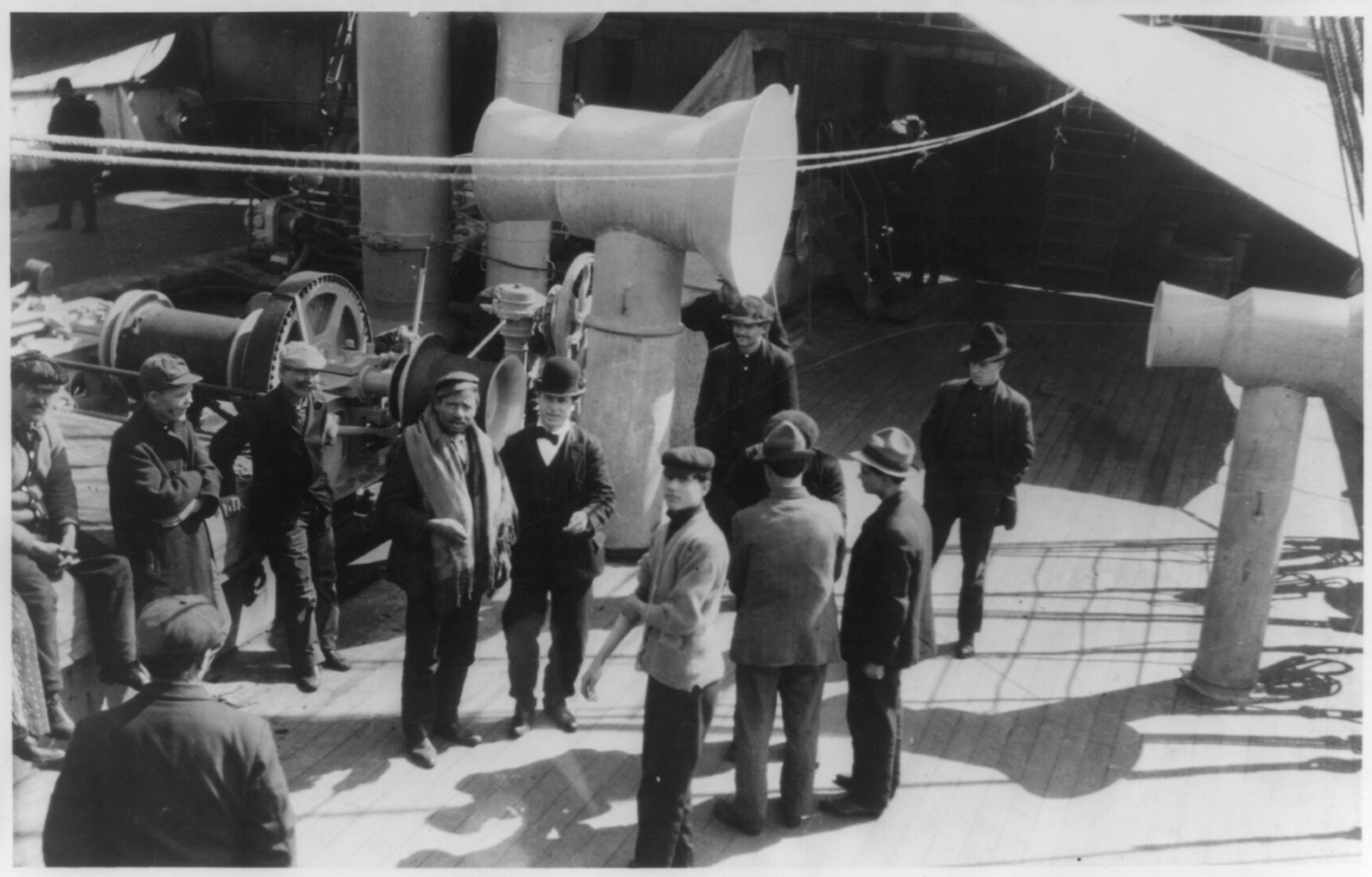
The large migration of the late nineteenth and early twentieth centuries is a central part of Italian American history. According to the Library of Congress's historical overview, more than four million Italians had come to the United States by 1920. Poverty, limited prospects in rural areas, natural disasters and the attraction of work abroad contributed to the movement; individual families had their own reasons for leaving. Library of Congress, The Great Arrival
Migration was not always a single departure followed by permanent settlement. The same overview describes people who intended to earn money and return, as well as money sent home to relatives. Family histories may therefore involve repeated journeys and relatives living on both sides of the Atlantic. A passenger's arrival date is one point in that story, not necessarily the beginning of uninterrupted residence.
Looking beyond an arrival date
To understand a family's migration, ask several connected questions: Who traveled first? Who joined them? Where did they find work? What relatives or neighbors were already there? Did someone return to Italy? Letters, passenger records, photographs and interviews can help answer different parts of the story.
The National Archives holds immigration-arrival records from approximately 1820 through December 1982, with gaps. Its guidance explains the records and research routes available. A family's port, date range and the spelling used in a particular record all matter. National Archives immigration records
Work and neighborhood life deserve attention alongside famous names. The Library of Congress's Italian Americans in the West project documented occupational, cultural and religious traditions in communities in California, Colorado, Utah, Washington and Nevada. The collection includes field recordings, photographs and interviews: evidence of lives that a national population table cannot describe. Collection guide
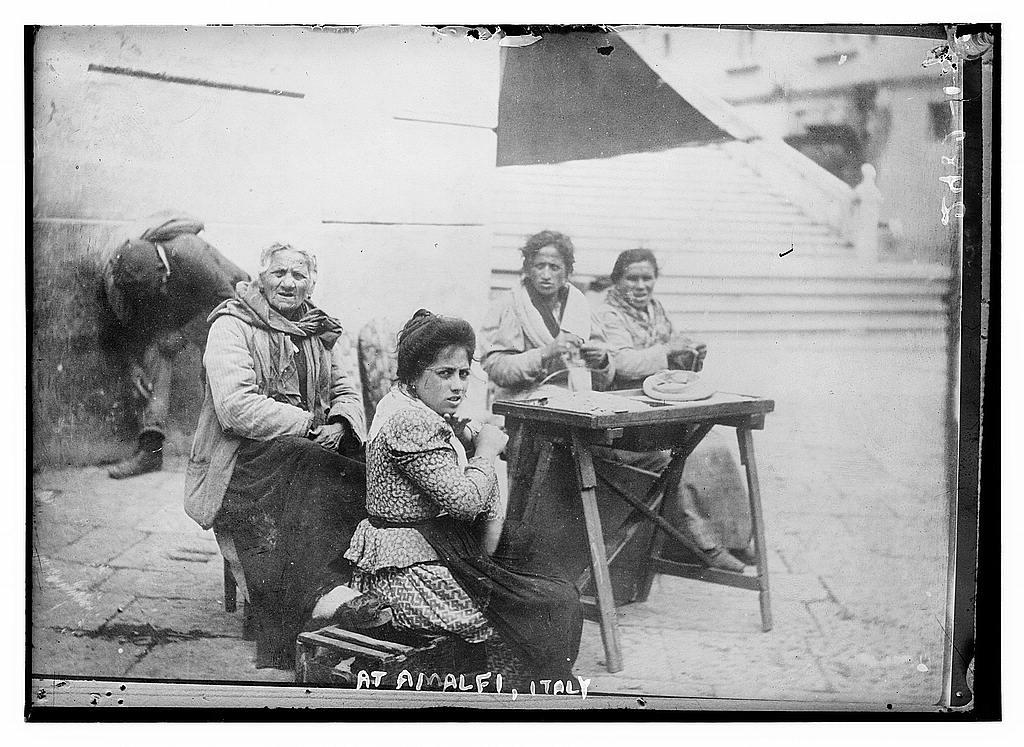
Photographs also preserve women's everyday experiences. A February 1912 photograph in the Library of Congress shows a woman carrying a large empty wooden box along New York's Bleecker Street. The National Child Labor Committee caption identifies her as Italian and says the box was to be used for kindling. The photograph is attributed to Lewis Hine on the basis of its provenance and cataloged among tenement-homework images. The caption preserves a detail of daily life, while leaving the woman's name and much of her story unknown. Library of Congress photograph and original caption
Immigration restrictions
The Immigration Act of 1924 sharply restricted entry through national-origin quotas. Its initial formula generally used two percent of the foreign-born population of each nationality recorded in the 1890 census. The State Department's historical account explains the law's restrictive purpose and subsequent development. It limited migration; it did not mean that every route of Italian immigration disappeared. Original 1924 Act, State Department historical explanation
For a family historian, that distinction is practical. A relative who arrived after 1924 is not an exception to history that must be explained away. Their own immigration and naturalization records are the place to establish what happened.
Discrimination and Civil Liberties
Italian American history includes episodes of violence and exclusion that require careful attention to both the people affected and the records left behind.
The 1891 New Orleans killings
In 1891, eleven people of Italian extraction were killed by a mob in New Orleans. Later diplomatic correspondence records that their citizenship statuses differed; describing all eleven simply as foreign nationals obscures an important part of the dispute. The correspondence also shows how the killings became a matter between the Italian and U.S. governments. State Department historical correspondence
President Benjamin Harrison's 1892 annual message records the United States' indemnity payment to Italy and the Italian government's response. Read together, the message and diplomatic correspondence trace how the governments responded to the killings. They are historical records written by officials with particular responsibilities and perspectives. Harrison's message
Italian immigrants during World War II
On December 8, 1941, President Franklin D. Roosevelt issued Proclamation 2527 concerning Italian “alien enemies.” Its terms applied to specified Italian nationals aged fourteen and older who were within U.S. jurisdiction and not naturalized. That legal category did not encompass every person with Italian ancestry. Proclamation 2527
The enemy-alien program and military exclusion measures should also be distinguished from one another. The National Archives describes the Department of Justice's role in hearings and internment after the wartime proclamations. Executive Order 9066 was a separate authority associated with military exclusion areas. Classification, curfew, forced removal, arrest and internment describe different actions and experiences. National Archives program overview
Congress enacted the Wartime Violation of Italian American Civil Liberties Act, approved November 7, 2000. Its findings state that government restrictions affected more than 600,000 Italian-born immigrants and their families; more than 10,000 Italian Americans on the West Coast were forced to leave their homes; more than 50,000 were subjected to curfews; thousands were arrested; and hundreds were interned. These categories overlap and must not be added together. Public Law 106-451, section 2
The law also recognized Italian Americans' wartime service. Holding these histories together gives a fuller account of the period: people could serve the country while relatives and neighbors experienced restrictions on their freedom.
Culture and Identity Across Generations
“Italian American” is a useful shared description, but it cannot tell a reader everything about a person's language, religion, race, politics, region of origin or relationship with Italy. An ancestry response establishes a reported connection; it does not prescribe what someone must do to belong. Census explanation of ancestry
For families exploring that connection, specificity is more useful than a checklist of supposedly universal traits. A recipe from a named relative, a photograph with a place and date, a workplace story or the name of a hometown gives the next generation something concrete to investigate. Similar customs can mean different things in different households.
Food, language and family memory
Food is a practical starting point for documenting heritage. Record who prepared a dish, what they called it, where they learned it and what changed over time. A family account can preserve valuable knowledge without proving that one household, city or country invented the dish. Distinguish a remembered origin story from a conclusion supported by dated records.
Language deserves the same care. Speaking Italian at home, taking a college language course and reporting Italian ancestry are separate measures. The Modern Language Association's fall 2021 survey counted 45,182 Italian course enrollments in U.S. higher education, a 20.4% decline from 2016. It counted enrollments rather than individual students and did not measure everyone learning or speaking Italian. MLA survey summary and methodology
Those figures cannot tell us whether an individual family has lost or renewed a connection to its heritage. Oral histories and family documents answer a different kind of question. When recording a relative's recollections, preserve their words, identify the speaker and date, and keep uncertainty visible: “I remember” and “the record shows” are both useful, but they are not interchangeable.
Contributions and everyday lives
Enrico Fermi's career connects migration with a collaborative scientific achievement. After leaving Italy with his family, Fermi arrived in New York in January 1939. On December 2, 1942, he led the University of Chicago team that achieved the first controlled, self-sustaining nuclear chain reaction. The university's archives preserve Fermi's U.S. naturalization certificate, dated July 11, 1944. University of Chicago archival exhibition
The archives also preserve a galvanometer graph and a December 1942 report documenting the experiment. These records connect a public milestone to the work of a research team; the naturalization certificate records a separate milestone in Fermi's life. Records of the chain reaction
A history of Italian Americans can include public achievement alongside the work of parents, laborers, business owners, artists, teachers and community volunteers. Readers interested in individual biographies can explore the Institute's notable Italian Americans directory and its research methodology. Read the sources and status attached to each entry rather than assuming that every biographical detail has the same level of verification.
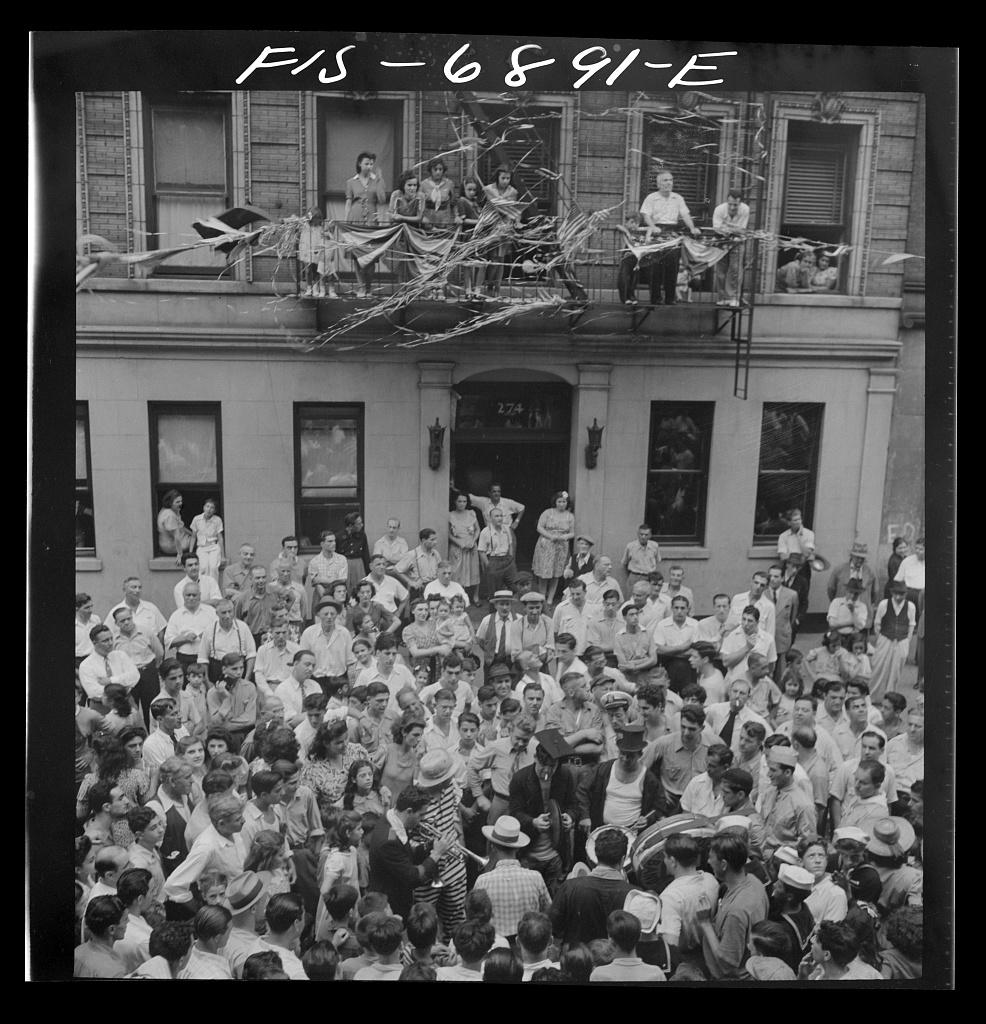
Neighborhood names and public festivals provide another route into research. Ask what institutions operated in a particular place, who participated, and how the community changed. A surviving restaurant, parish photograph or reunion program can be a starting point; none alone establishes the experience of every resident or descendant.
How to Explore Your Italian American Heritage
Start with one person, place or object. A small, well-documented account is easier to build on than an ambitious family narrative whose sources have disappeared.
- 1.Record what you already know. List names, approximate dates, places and the source of each detail. Keep family recollection separate from information copied from records.
- 2.Ask relatives about ordinary life. Work, school, travel, friendships, language and celebrations often reveal connections that a list of birth dates misses. Ask permission before recording or sharing an interview.
- 3.Look for original records. Use the National Archives immigration guide to understand available arrival records and their limitations. Compare dates and relationships before deciding that a similar name belongs to your relative.
- 4.Place the story geographically. The Institute's genealogy resources and Italian surnames guide offer starting points for exploring places and names. Record the town as it appears in the source, and preserve alternate spellings instead of silently choosing one.
- 5.Save evidence with the story. Keep an image or reference for each document, including the repository, collection and date accessed. Label uncertain identifications so another researcher can follow your reasoning.
For broader study, begin with the Library of Congress Italian immigration overview, its Italian Americans in the West collection, and the National Archives' wartime enemy-alien records guide. The Institute's resource collection offers further starting points.
To explore the Institute's family-story project, visit the Digital Piazza. Keep the distinction between a personal account and corroborating records when preserving or sharing a story.
If you are planning activities for October, continue to the separate Italian American Heritage Month guide. It focuses on the observance and ways to participate; this page provides the year-round historical and demographic foundation.
For one practical October activity, save a family story from a photograph or conversation. The free family-history starter kit can help you write down names, places, and questions before searching records. You can download it without signing up, and you can keep the story within your family.
About the Evidence in This Guide
Population figures come from the 2024 ACS one-year estimates, not a mix of one-year and five-year products. National ancestry uses B04006, Italian row 51; geographic comparisons use C04006, Italian row 16; the separate detailed-race comparison uses B02024, Italian row 19. The national denominator is 340,110,990. Counts, margins of error and geography labels were checked against the Census Bureau's downloadable source tables and table definitions.
The historical sections distinguish original laws, proclamations and diplomatic documents from later institutional explanations. A collection of personal accounts can illuminate lived experience without representing every Italian American. Where a precise statistic or sweeping historical claim could not be substantiated, this guide leaves it out.
To suggest a correction, contact the Institute with the passage and the supporting source. Last updated October 1, 2026.