Enrico Fermi
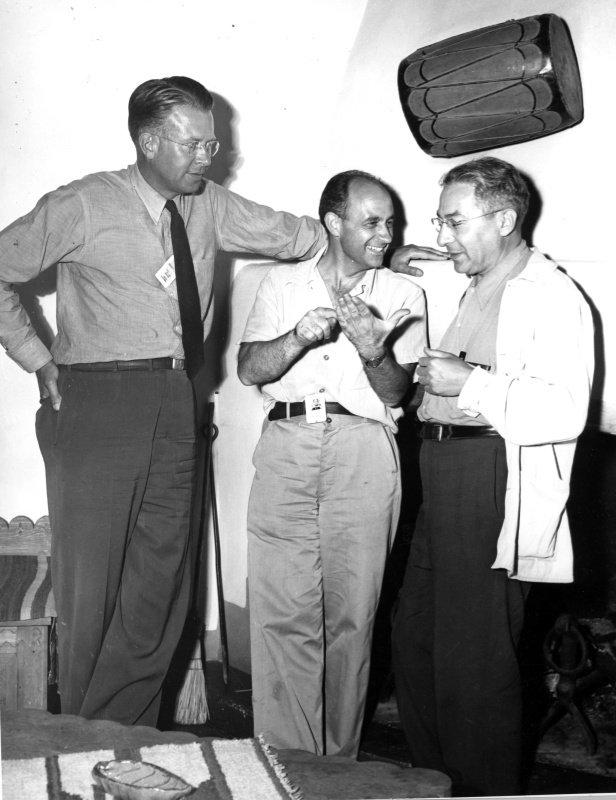
Ernest O. Lawrence, Enrico Fermi (center), and Isidor I. Rabi at Los Alamos, 1945.
Los Alamos Scientific Laboratory; Harry S. Truman Library & Museum, accession 72-4165 (NAID 348448677).. Public domain
Why Included
Italian-born physicist and 1938 Nobel laureate who led the University of Chicago team that achieved the first controlled, self-sustaining nuclear chain reaction in 1942 and became a U.S. citizen in 1944.
Biography
Enrico Fermi was an Italian-born physicist whose work combined mathematical theory with experiments on the behavior of matter. Born in Rome on September 29, 1901, he received his doctorate from the University of Pisa in 1922. He later taught in Florence and Rome, building a scientific career in Italy before moving to the United States. His contributions included work associated with Fermi–Dirac statistics and a theory of beta decay, alongside the neutron experiments for which he received the 1938 Nobel Prize in Physics.
The prize recognized research involving neutron irradiation and nuclear reactions produced by slow neutrons. Fermi received the Nobel Prize in 1938, four years before the Chicago experiment.
His family's move to America took place amid the tightening restrictions of Fascist Italy. With his Jewish wife, Laura, Fermi was increasingly concerned about antisemitic laws and interference with scientific work. He left Italy with Laura and their two children in December 1938 to attend the Nobel ceremony in Stockholm. Rather than returning to Rome, they traveled onward, arriving in New York on January 2, 1939. He took up a professorship at Columbia University and began collaborating with Herbert L. Anderson.
On December 2, 1942, a team led by Fermi achieved the first controlled, self-sustaining nuclear chain reaction beneath the west stands of the University of Chicago's Stagg Field. The University Library preserves a galvanometer graph from the experiment and a report of the Metallurgical Project's work that December. These records place the achievement within a collaborative wartime research program. It was a demonstration of a controlled reaction, not a commercial electricity-generating station.
Fermi's U.S. naturalization certificate is dated July 11, 1944. He also worked at Los Alamos during the Manhattan Project, contributing to the development of nuclear weapons. In 1946 he returned to the University of Chicago as a professor at its Institute of Nuclear Studies, pursuing research in nuclear and elementary-particle physics. His American career therefore included both military research and university teaching and investigation.
Fermi died in Chicago on November 28, 1954. The Enrico Fermi Award was established in 1956 to recognize scientific achievement. His papers document his scientific career in Italy, his work in American institutions and his role in wartime research.
Notable For
- Research on neutron irradiation and slow-neutron nuclear reactions
- Leadership of the team that achieved the first controlled, self-sustaining nuclear chain reaction (1942)
- Contributions to theoretical and experimental physics
- Research and teaching at Columbia University and the University of Chicago
Honors & Recognition
- Nobel Prize in Physics (1938)
Frequently Asked Questions
Where was Enrico Fermi born?
Fermi was born in Rome in 1901 and became a U.S. citizen in 1944.
Articles about Enrico Fermi
Famous Italian Americans: Six Stories Behind the Names
· 8 min read
Meet six famous Italian Americans through schools, science, sport, film, music and a historic campaign—and explore the records behind their stories.
Introducing the Notable Italian Americans Directory
· 10 min read
Meet Italian Americans in politics, science, sports, culture, and community life. Explore their profiles, sources, and the directory’s selection criteria.
Italian Americans: History, Population, Culture & Identity
· 19 min read
Explore Italian American history, communities, culture and contributions, with carefully sourced population figures and ways to research your family heritage.
Explore the wider history of Italian Americans.
If you believe this entry contains an error, outdated information, or a sourcing issue, we want to hear from you.
Quick Facts
- Field
- Science & Technology
- Specialty
- Physics
- Years
- 1901–1954
- Birth Place
- Rome, Italy
- Origin
- First-generation immigrant
- Publication Status
- Published
- Ancestry Verification
- Confirmed
More in Science & Technology
- Dr. Michael DeBakey(1908–2008)
- Vincent Dole(1913–2006)
- Leo Esaki(b. 1925)
- Federico Faggin(b. 1941)
The list grows through community nominations. Help us expand toward 1,000.
Nominate a figure →