At 19 North Square, the building we call the Paul Revere House once carried a sign for Banca Italiana. In a photograph that the City of Boston dates to around 1900, the words run across the front above the storefronts. Boston's archaeology program describes the same property as a tenement with ground-floor businesses in the late nineteenth and early twentieth centuries. It opened as a museum in 1908. One address takes you from the city's Revolutionary history to the working life of an immigrant neighborhood. City of Boston property history and photograph
If your family papers mention Boston's North End, start with that kind of detail. A street number on a letter, a parish on a marriage record or a shop name on the back of a photograph can give you a place to begin. The North End has several ways to explore Italian American history. The right one depends on whether you're trying to identify an address, find a family record or hear how people remember the neighborhood. Access information in this guide was checked against institutional pages on November 14, 2026. Check those pages again before planning a visit.
What two North Square photographs can tell you
Two archives hold views of the storefront. In the clearer City of Boston Archives photograph, look for Banca Italiana and F.A. Goduti & Co. The archive gives the frame an approximate range of 1890–1915 and identifies it as file 5210004_02_040 in collection 5210.004. Historic New England's separate frame, H-1138c, has a catalog range of 1890–1939. Its catalog identifies other Italian-language signs advertising cigars and shipping. Record each archive's reference and date range separately. City Archives photo record · Historic New England photo record
The site's archaeology report connects the signage to the property's uses. It identifies the building as a tenement and records a grocery and the F.A. Goduti & Co. cigar manufactory under Sidney F. Squires's ownership. Figure 3-13 reproduces an 1895 map detail showing North Square and the surrounding blocks. The report supplies the property chronology. The photographs preserve what was advertised at the street. City-posted archaeology report, printed pages 18, 26 and 28
A useful question after seeing the sign is “Who was listed at this address, and in which year?” In an older Boston directory, try the business name or a category such as banks or cigar manufacturers, then compare the address printed in the result. If you are looking for a person, compare the name, address, occupation and year with a second record before joining the entries. Boston Public Library's directory guide
Boston's archaeology account traces the North End through several periods of immigration, including earlier Irish settlement and later Eastern European Jewish and Italian settlement. That sequence helps explain why the same streets turn up in records belonging to very different families. It also makes room for what might be in your own papers: people moved, employers changed and a family could use several Boston addresses over time. Boston archaeology's neighborhood account · Paul Revere House's North End history
Where to look for names, addresses and records
City directories. Boston Public Library's guide links to digitized Boston directories covering 1789–1975 with gaps. The library dates the first separate by-address listing in the Boston City Directory to 1930. For an earlier edition, begin with a person's surname or the business section. Save the edition year, page or image number and the entry as printed, including any abbreviation you cannot yet expand. Boston directory guide
Municipal resident lists. For a known address, try the separate City of Boston Lists of Residents. The library's guide includes early holdings on microfilm and directs readers to scanned volumes, including 1909 and 1910 where available. Through 1984, the city arranged the listings by address. The guide's street lists can help narrow the search to a ward and precinct, whose boundaries can change over time. Boston Lists of Residents · 1909–1910 volumes and gaps · Boston Street Lists
Maps, building records and city photographs. A historic map can help locate an address relative to an intersection or a property next door. Browse the Library of Congress gallery for the 1909 Boston Sanborn volume, using its index to select a sheet. For later alterations or the history of a structure, Boston City Archives describes Building Inspector reports for 1879–1903, with gaps, and surviving plans from 1902–1969. Coverage varies by property. Capture the map edition and sheet or the municipal collection reference before comparing an old address with a modern one. 1909 Boston Sanborn gallery · BPL map and atlas guide · Boston building records
Boston City Archives access. The city asks researchers to identify materials in its catalog, contact the Archives at least a week ahead and wait for an appointment confirmation. The construction notice says some records are stored offsite through spring 2027, with at least five business days needed to bring them back for research. Same-day and walk-in requests are unavailable during this period. The notice also links to the digital repository, a place to start from home. Current City Archives access notice
Civil births, marriages and deaths. The Massachusetts Archives holds statewide vital records for 1841–1935. It points researchers to free digitized copies through FamilySearch for 1841–1930, and notes that digitization of recent transfers is still in progress. The Commonwealth's own 1841–1910 search provides volume and page references. Its Registry of Vital Records and Statistics holds statewide records from 1936 onward. For older records or a city-held copy, use the custodian's directions to identify the municipal office for the event. The same instructions distinguish a research copy from an official certified copy. Massachusetts Archives vital-records access · Commonwealth volume and page lookup
Catholic parish records. The Archdiocese of Boston describes a browsable, image-only American Ancestors collection for 1789–1920 that requires a free guest account. Full members can use a separate database with indexed name searches and typed transcripts. American Ancestors' announcement of the member database's St. Leonard of Port Maurice additions lists a marriage volume for 1873–1899. For guest browsing, check which volumes your parish and year have in the image-only collection. Compare a parish entry with a civil record when both survive, especially when two people in your research share a name. Archdiocese digital collections · St. Leonard member-database announcement
Arrivals and naturalizations. Keep the known Boston address in your notes while you investigate the port and court separately. The Massachusetts Archives describes passenger lists for the Port of Boston from 1848–1891 under its state recordkeeping program. Its guide traces later custody to federal recordkeeping. For citizenship records, Massachusetts Judicial Archives gives different routes for state and federal courts and for different periods. Copy the court name and file reference before looking for the underlying record. Massachusetts Archives family-history guide · Judicial Archives naturalization guide
Places that tell the neighborhood's story
- North End Historical Museum, 3 Prince Street. The museum's visitor page describes its single-level gallery and captioned oral-history videos. It lists admission and accessibility details, including the limits of its restroom access. If a recorded memory reminds you of a family story, write down the exhibition or speaker and what you heard. Keep that observation alongside any dates or names you later verify in records. Museum visitor information
- Paul Revere House, 19 North Square. Read the city's property history and look at the old storefront photograph before visiting. The museum posts seasonal hours and holiday closures. Its notice separately lists the Pierce/Hichborn House as closed until further notice. Museum hours and access
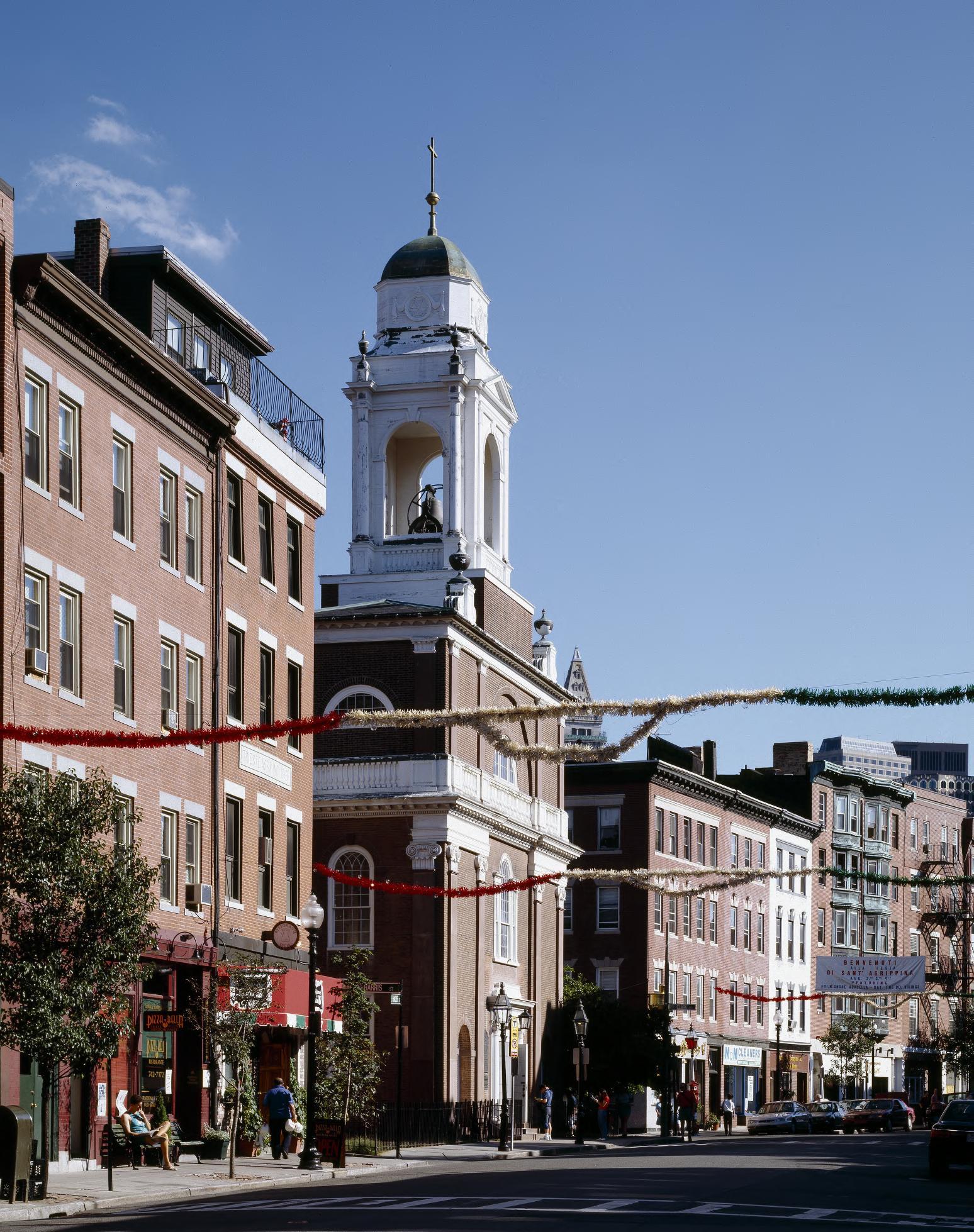
- St. Leonard of Port Maurice Parish. The Archdiocese dates the parish's establishment to 1873. The parish traces the upper church's consecration to November 6, 1899, and identifies St. Leonard and Sacred Heart as its two worship sites today. Use the parish site for current services and the archival collection for historical register research. Archdiocese researcher resources · St. Leonard parish history
- North Bennet Street School. The school's own timeline traces its work to the North End Industrial Home established in 1881 and records formal incorporation as the North Bennet Street Industrial School in 1885. Early programs taught employment skills and provided social services. In the early twentieth century it formalized its settlement-house work. The timeline shows what neighborhood institutions could offer newcomers beyond a place to worship or a place to work. North Bennet Street School history
- Boston Public Library's North End branch, 25 Parmenter Street. The neighborhood branch lists public computers, scanning services and local events. Its regular schedule lists Sunday closure. The library's directory guides and the separate City Archives catalog can help you plan the research itself. North End branch access and programs
Bring one question to the next search
Write down the name or business as it appears in your own source, the Boston address, the approximate year and the question you can answer first. Save a directory entry or map reference, then look for a civil or parish record if you need evidence about a person. An incomplete search is worth recording too. “This edition had no listing under the spelling I checked” tells you exactly where to resume.
Use the Italian genealogy hub to keep following the family-history question. For a neighborhood event, start with the Italian American feasts and festivals calendar, then confirm the date with its organizer. If the family address leads to another city, see our New York and New Jersey community guide.