Rossi is a familiar name with a history worth exploring. It can also make a family search feel crowded: similar names appear in different places, in different kinds of records, and in more than one language. The most productive starting point is a person you can identify, with dates, places and relationships attached.
Published surname research can explain how a name developed. An original document can help you investigate a particular bearer. Keeping those two purposes clear allows the history of Rossi to enrich your research while your own family story takes shape through evidence.
Here is a source-based introduction to the name, followed by two actual National Archives examples and a practical way to organize your next search.
What does the surname Rossi mean?
The Dictionary of American Family Names, second edition, describes Italian Rossi as a patronymic or plural form of Rosso. A patronymic is a name formed through a paternal name connection. The complete Rossi entry also records a Greek/US pathway through Rossis, reminding us that one written form can have more than one linguistic history. The entry is available in a credited republication on Ancestry. DAFN, Rossi entry
For the Italian word behind that explanation, Treccani records rosso, “red,” from Latin russus. Its dictionary includes uses referring to hair, beard and complexion, alongside many other senses. A dictionary explains a word's uses; it does not tell us what a particular ancestor looked like. Treccani: rosso
Onomastician Enzo Caffarelli, writing about color surnames in 2025, associates Rossi especially with historical descriptions of hair and beard. He also distinguishes the history of a name as a linguistic form from the history of an individual family. That distinction is useful when a surname's apparent meaning feels like a ready-made family story. Caffarelli, “Italiani, popolo a colori”
Write the etymology in a background note. Reserve your family tree for people whose relationships you can document. An early ancestor's actual nickname, the moment a surname became hereditary in that family, or the reason it was adopted will require evidence specific to that history.
Related names: useful comparisons, separate research questions
The dictionary's Rosso entry includes a nickname and personal-name explanation associated with red appearance. Its De Rossi entry describes a patronymic from Rossi. Its Russo entry identifies a southern Italian form connected with rosso. These are documented linguistic comparisons, rather than evidence that two named people are relatives. Rosso, De Rossi, Russo
| Name encountered | What the cited scholarship supports | What to check in a family search |
|---|---|---|
| Rossi / Rosso | A name-formation relationship in DAFN | Whether the actual records identify the same person or family |
| De Rossi | A patronymic formation from Rossi in DAFN | Whether the prefix appears in this person's documents, and when |
| Russo | A related southern Italian form in the cited sources | The person's own places, relatives and recorded name forms |
| Rossini / Rossetti | Examples in Caffarelli's discussion of related name formations | Independent evidence before connecting a bearer to your Rossi line |
Caffarelli discusses Rosso/Rossi alongside suffixed forms including Rossini and Rossetti in his account of Italian personal-name formations. The linguistic relationship gives a researcher something to investigate; it does not collapse all those surnames into one pedigree. Caffarelli, “Cognomi in Italia”
Keep a search form separate from a recorded form. If you try Rosso while searching for a person usually called Rossi, note that it was your search choice. Add it as an actual name variant only when a source supports that use for the person being researched.
What a regional pattern can tell you
In his 2023 article devoted to Rossi, Caffarelli describes its strong central and northern distribution, discusses Rosso in Piedmont and Liguria, and compares southern Russo. His account also considers how migration affects where surnames are found. Read those observations with their date and scope attached. Caffarelli, “Finisce l’era del signor Mario Rossi”
For your own family, a place written in a record is a more specific lead than a surname's broad distribution. Ask which place is being reported: a birthplace, a residence, a departure point, or the location where the document was created. Those may all be different.
Once you have a place, investigate its exact historical jurisdiction and the records it produced. A familiar regional association can remain in your background notes while the evidence determines where your search goes next.
Example one: a Rossi index card that points further
The National Archives item Rossi-43, identifier 239699782, belongs to the Name Index to Bureau of Naturalization Correspondence Files, in Record Group 85. Its microfilm reference is A3388, roll 16, image A3388-016-082-037. The series covers 1906–1946; that span is not an individual event date. National Archives catalog: Rossi-43
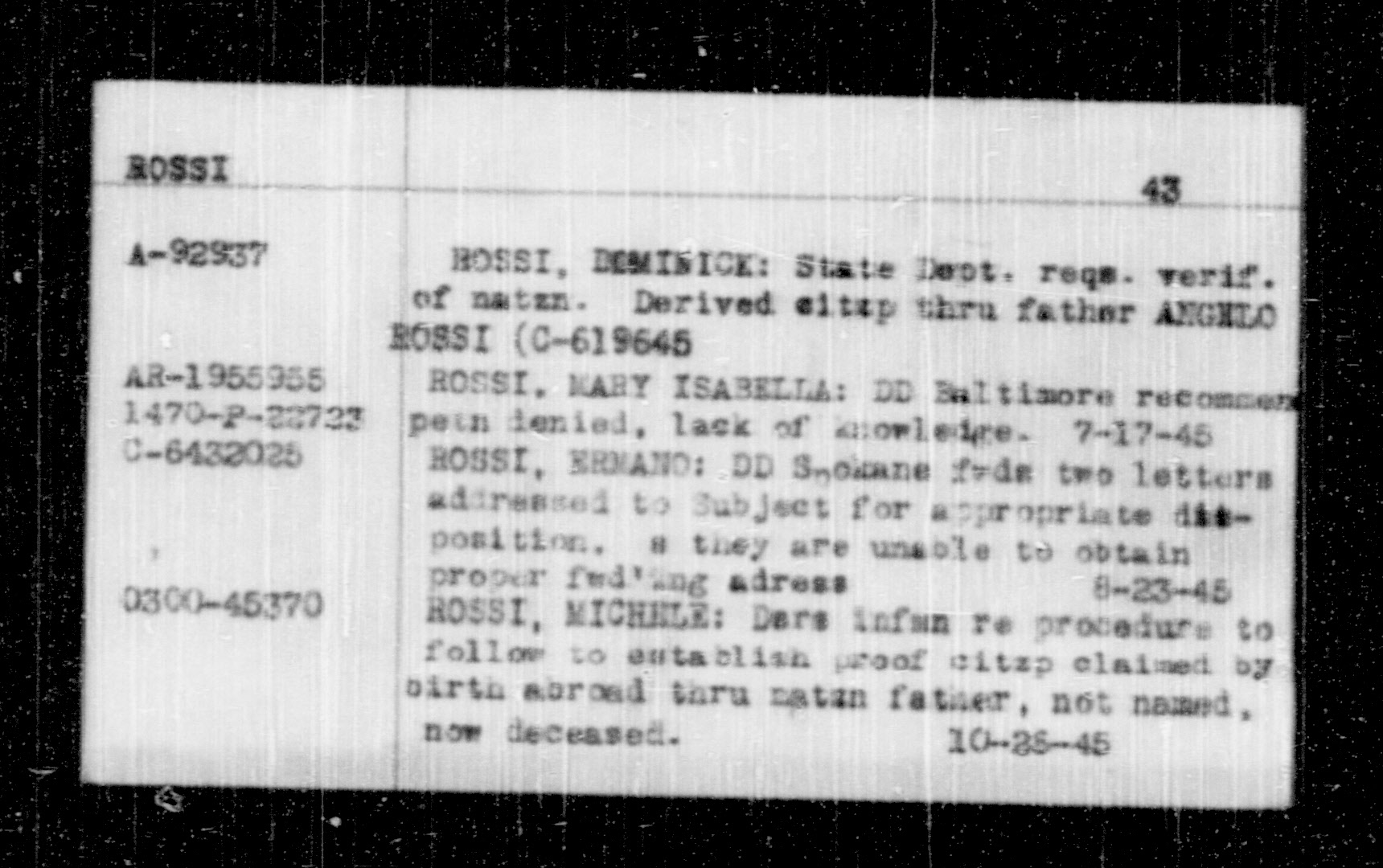
At the top of the card, the typed entry names DOMINICK ROSSI, carries reference A-92537, and records a derivative-citizenship statement through his father, ANGELO ROSSI, with C-619645. Those are the index's statement and references. The underlying file and certificate have not been examined for this example. No individual date is visible in that top entry; dates elsewhere on the card belong to other entries.
The research task is now more precise: preserve the index citation and investigate the referenced material. An index can supply a route forward without establishing the complete facts of the case by itself.
Example two: a similarly named person in a different record set
A separate catalog file, Rossi, Dominic, identifier 230167908, is in the Merchant Marine Applications for Licenses of Officers series, Record Group 26, Records of the U.S. Coast Guard. One image, digital object 230167912, is an Application and Certificate of Visual Examination naming DOMINIC ROSSI at Los Angeles. The document and surgeon's section bear June 27, 1918; a received stamp bears June 28. National Archives catalog: Rossi, Dominic
The two dates describe different document actions. Neither should silently replace the other in a research note. The file's catalog hierarchy also supplies its archival context, which is more reliable than guessing a record group from a digital file path.
No identification linking this Dominic to the Dominick on the correspondence index has been established here. The names are worth comparing; an identity claim would require additional connecting evidence.
Build an identification note before expanding the search
The National Archives recommends beginning with what you know and using names, dates, places and relationships to identify people. That provides a manageable starting point when a surname produces many results. NARA: How to Begin Genealogical Research
Choose one person and one question. You might want to locate a parent's name, distinguish two people in a town, or find a document referred to by an index. Write down what would help answer that question before collecting more records.
| Field in your research note | What to preserve |
|---|---|
| Name as recorded | The source's spelling, initials, prefixes and given names |
| Document identity | Archive, collection or series, item/file identifier and image/page |
| Dates and places | Each date's role and each place's stated meaning |
| Relationships | The source's actual relationship statement, with its limits |
| Supporting or conflicting details | Details that help distinguish candidates, without silently correcting them |
| Next action | A specific record, reference or question to investigate |
Leave room for separate candidates. Two people can remain on your research list until you have enough evidence to decide between them. A neat tree is less useful than a note that clearly shows why an identification is still open.
Compare the image, the index and your conclusion
NARA's census guidance cautions that names and other details can be recorded differently than expected, and recommends using additional personal details to distinguish people with similar names. It also advises recording a citation and checking actual pages when search results fall short. These are useful habits to bring to a Rossi search. NARA: Census research tips, especially 4–6 and 18–19
Use three labels in your notes: what the document says, what an index says, and what you conclude. If they disagree, retain the disagreement. A transcription can be corrected later without losing the original observation that led you to investigate it.
When a letter or digit is unclear, mark that uncertainty rather than filling it from a surname dictionary. Compare another occurrence on the same page, seek a clearer image, or bring the passage and its surrounding text to someone qualified to read that record type. A suspected spelling should remain a question until the evidence supports it.
Turn a promising lead into the next document
For the index-card example, the next question concerns referenced files. For the merchant-marine example, the next question might concern another document in that catalog file or evidence that identifies the applicant elsewhere. The record's purpose helps determine a sensible next step.
For your family, build the sequence from a known person toward an earlier record. Compare relatives, dates and places across the sequence. Preserve a full image and citation when you can, along with the date you accessed it. Record the searches that failed too, so you know what you have already tried and can revisit them when a new clue appears.
A surname explanation can accompany this work, but the personal detail comes from the records: a named relationship, a move, an occupation, a signature, or the way a clerk recorded someone's name. Each needs its own source and should be described only as far as that source allows.
If a U.S. record supplies a possible Italian town, our guide to finding an Italian ancestral town in American records offers a next research task. Keep the place as a lead until you have checked what the record actually identifies.
Make your Rossi story identifiable
The history of Rossi opens several paths into language and migration. Your family's path becomes clearer as each person acquires a documented setting and a traceable relationship to the next.
Start with one record you can cite. Keep its exact name, explain its dates and references, and write the next question it raises. That is how a familiar surname begins to become a particular family history.