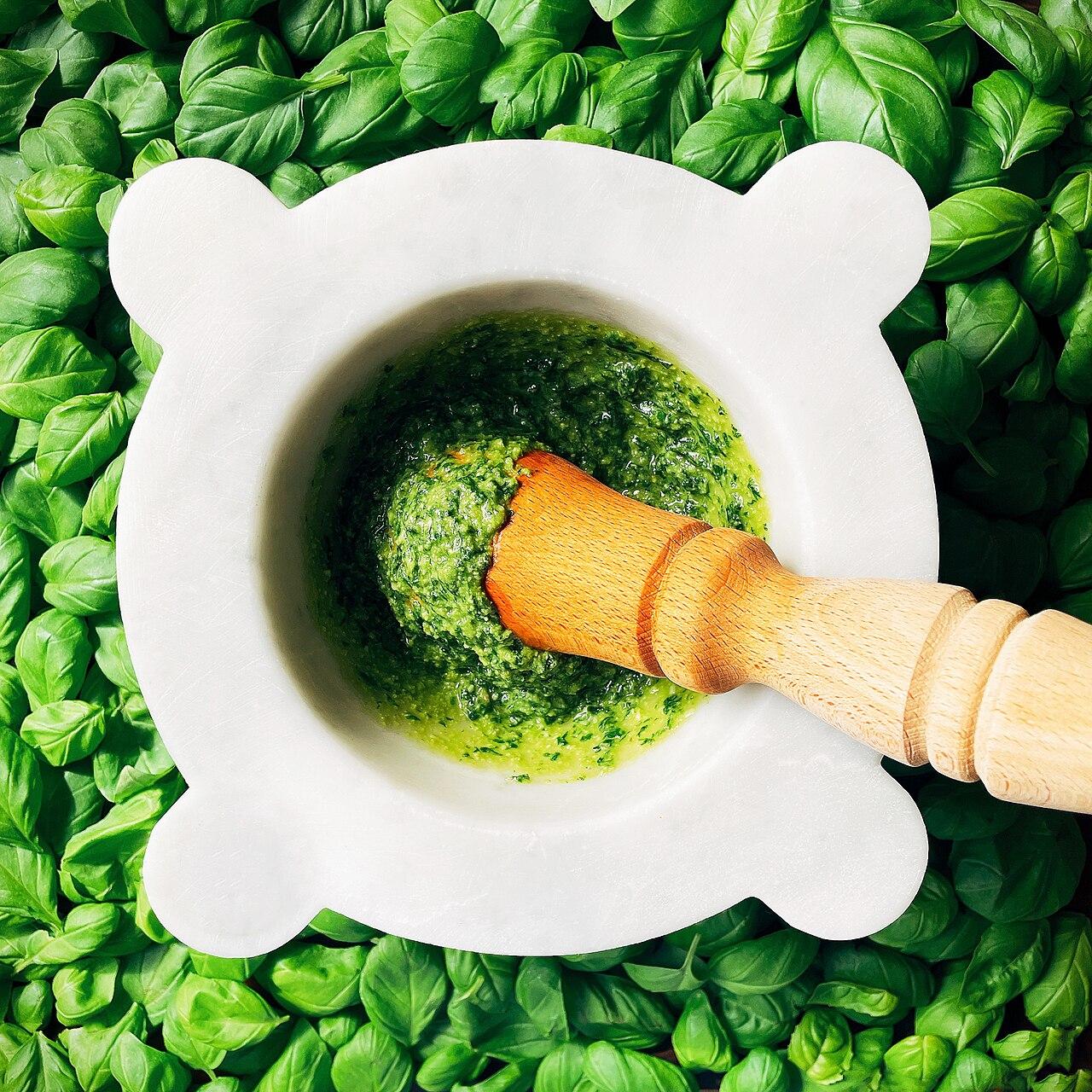
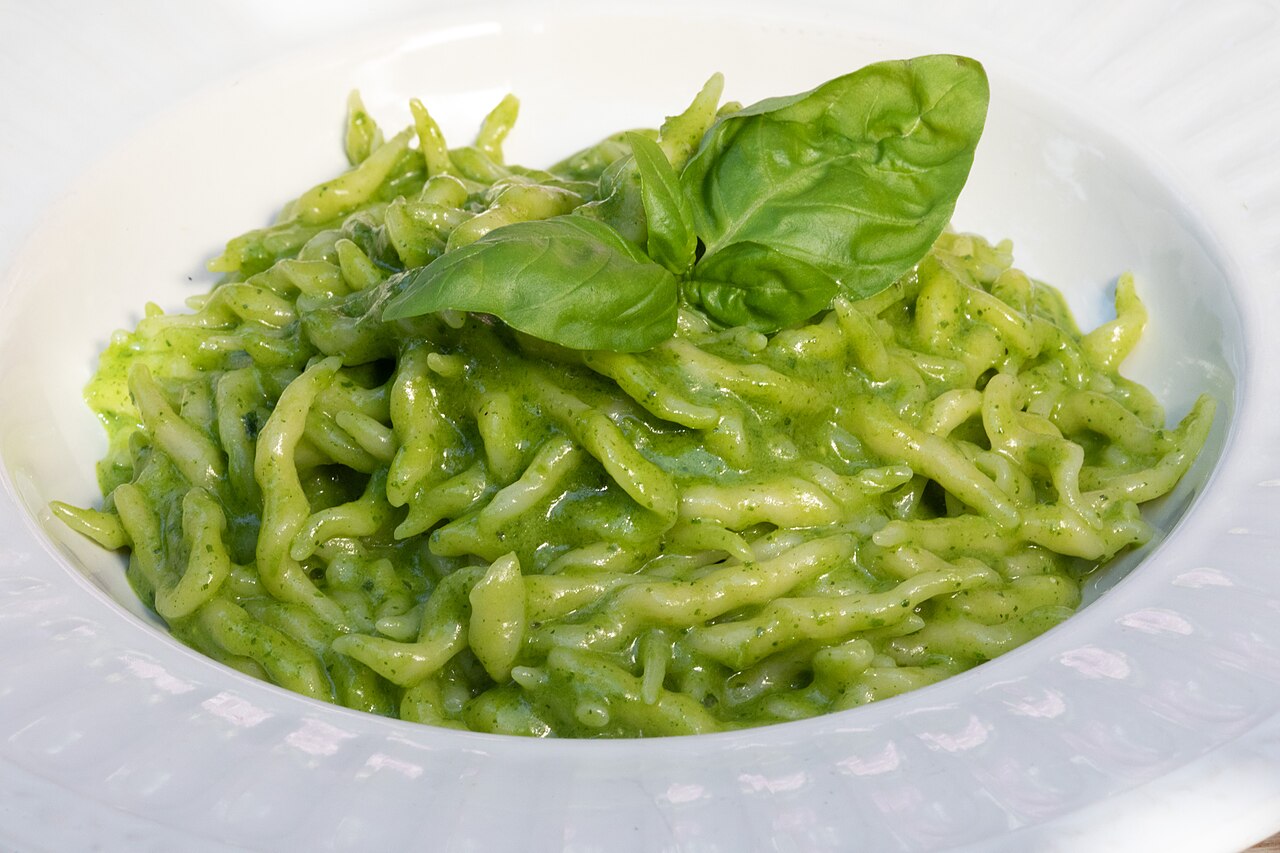
A handful of fresh basil can fill a kitchen with fragrance before the sauce is finished. Add garlic, nuts, grated cheese and olive oil, and the result is pesto: a sauce closely associated with Genoa that has found a place in kitchens far beyond Liguria.
In an American home, the basil might come from a backyard pot, a grocery store or an indoor garden. The nuts might be pine nuts or walnuts; the tool might be a mortar or a food processor. Those choices deserve a place in the story, alongside the regional tradition that gives pesto alla genovese its name.
The sauce’s journey passes through nineteenth-century cookbooks, immigrant gardens and the work of writers who introduced regional Italian cooking to American readers. Start with a batch of basil pesto, then follow the history behind it.
Basil pesto for the home kitchen
This home-kitchen version offers a choice of pine nuts or walnuts and combines Parmigiano-Reggiano with pecorino. A food processor makes it convenient, while brief pulses give you control over the texture. Weigh the basil when possible: a cup of loosely gathered leaves and a cup of tightly compressed leaves can hold very different amounts.
Approximate yield: 1½ cups, depending on the oil and how finely the ingredients are chopped.
Preparation: About 20 minutes, with additional cooling time if you toast the nuts.
For serving: Start with 1 pound (450 g) of pasta and add pesto to taste.
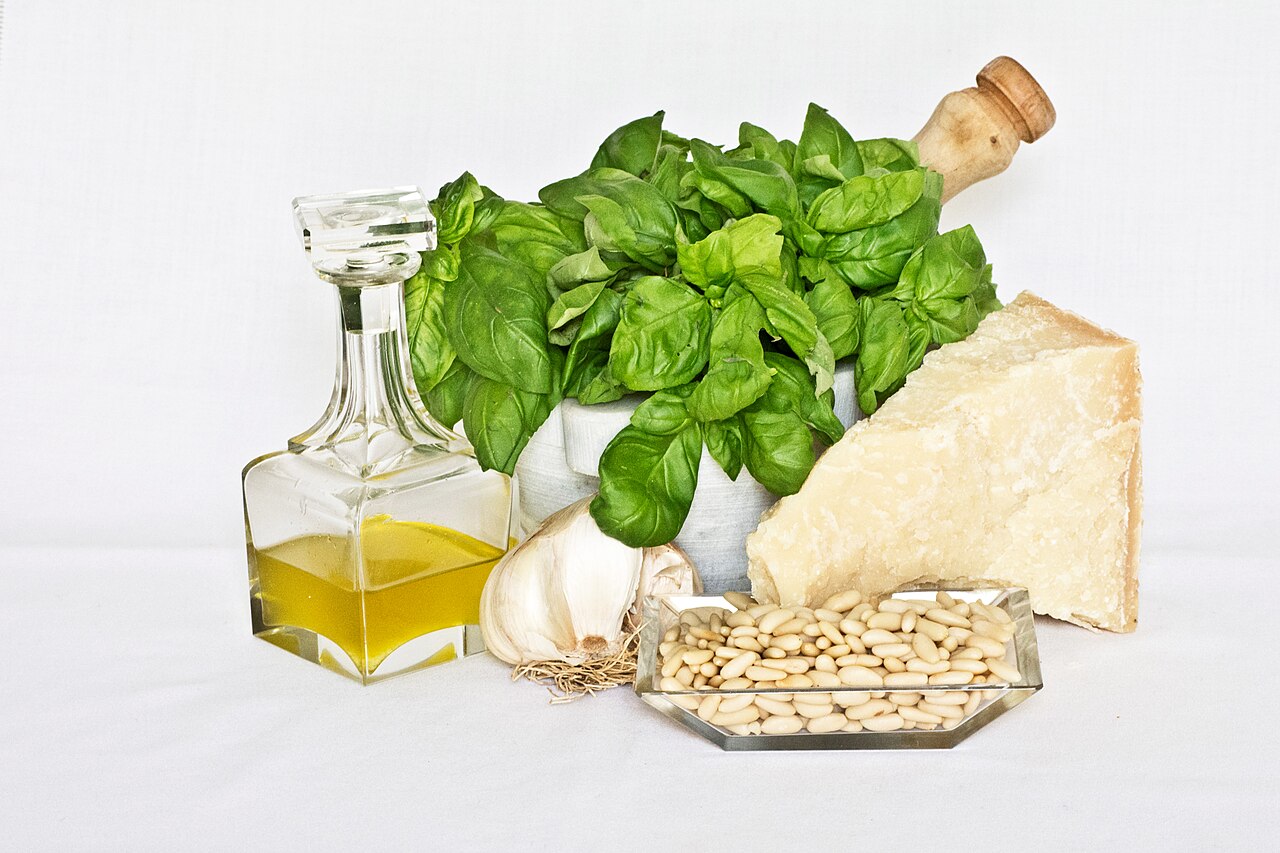
Ingredients
- 85 g (3 ounces) fresh sweet basil leaves, roughly 3 packed cups; tough stems removed.
- ⅓ cup pine nuts, or the same volume of walnut pieces, or a mixture of the two.
- 1–3 medium garlic cloves, peeled. Roughly chop 1–2 to start, reserving any additional garlic for the final adjustment.
- ¼ teaspoon fine sea salt, plus more to taste after adding the cheeses.
- ½ cup (120 ml) extra-virgin olive oil, plus up to another 2–3 tablespoons as needed.
- ½ cup freshly grated Parmigiano-Reggiano.
- ¼ cup freshly grated Pecorino Romano or Fiore Sardo.
- Optional: 1 tablespoon softened unsalted butter, for a richer finish.
Pine nuts give the familiar Genoese combination; walnuts make a useful variation. Toasting is optional, too. Leave the nuts raw for a gentler flavor, or toast them lightly for a more pronounced nutty taste. A little butter adds richness if you enjoy that finish.
Method
- 1.Wash and dry the basil. Wash your hands and rinse the leaves gently under running water. Spin or pat them dry with a clean towel. Remove damaged leaves and tough stems. Drying removes excess surface water; it does not require dehydrating or squeezing the leaves. These basic washing steps follow FDA produce-handling guidance.
- 2.Prepare the nuts. If you want to toast them, stir them in a dry skillet over medium-low heat until fragrant and lightly colored. Transfer them to a plate and let them cool completely. Raw nuts can go straight into the processor.
- 3.Chop the garlic and nuts. Add them to the processor with the salt. Pulse until finely chopped, stopping to scrape down the bowl. Follow your appliance’s instructions when handling the blade.
- 4.Add the basil and oil. Add the basil and a few tablespoons of the measured oil. Pulse briefly, scrape down the sides, and add the rest of the ½ cup of oil gradually. Stop when the mixture forms a spoonable paste with some texture. Avoid running the machine longer than needed.
- 5.Stir in the cheese. Transfer the mixture to a bowl and fold in both cheeses and the optional butter. Add a little of the extra oil if the pesto seems too stiff. Taste before adding more salt. For a stronger garlic flavor, stir in a little finely grated reserved garlic.
- 6.Dress the pasta off the heat. Reserve about 1 cup of the pasta’s cooking water before draining. Put the pasta in a serving bowl, add pesto, and toss with a tablespoon or two of cooking water at a time until the sauce coats it evenly. You may not need all the pesto or water. The goal is a light coating, without a pool of oil at the bottom of the bowl.
For a mortar version, crush the garlic and salt first, then work in the nuts and basil in manageable handfuls. Stir in the cheese and oil. Oregon State University Extension’s pesto recipe describes both machine and hand methods, as well as optional toasting.
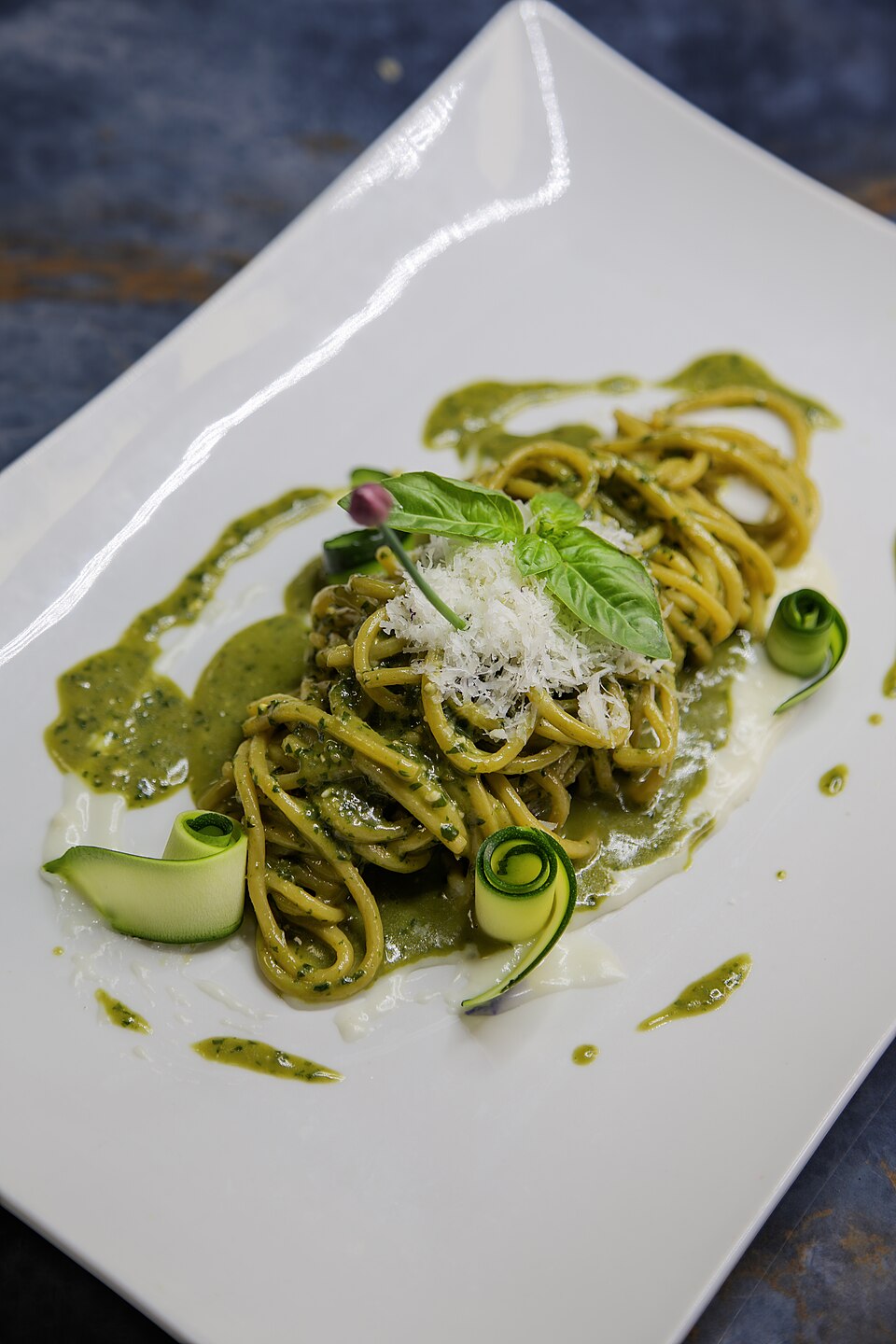
Using garden or hydroponic basil
An indoor harvest can work well here. Choose fragrant sweet basil, wash and dry the leaves, and add the oil gradually. Taste the basil before you begin, then adjust the garlic and cheese to suit that batch.
Growing method alone does not tell you how watery or anise-scented basil will be. A study of three hydroponically grown Genovese cultivars found differences in dry matter and aroma among cultivars and harvest treatments. It gives us a reason to pay attention to the particular basil in the bowl, rather than prescribe one correction for every indoor harvest. (Ciriello and colleagues, 2021)
Refrigeration and freezing
Refrigerate homemade pesto promptly and use it within 3 days, or freeze it. The National Center for Home Food Preservation recommends that three-day refrigerator limit. Keep the refrigerator at 40°F (4°C) or below. Refrigerate pesto within 2 hours of preparation or serving, or within 1 hour when the temperature is above 90°F (32°C), following FDA food-handling guidance.
For freezing, use small freezer-safe containers, leaving ½ inch of headspace, or freeze small portions in a tray and transfer the solid portions to an airtight freezer container. Label with the date and thaw in the refrigerator. An oil covering may limit contact with air, but it does not replace refrigeration or extend the storage period. This is a fresh or frozen sauce: the National Center for Home Food Preservation provides no home-canning recommendations for pesto.
What makes pesto alla genovese distinctive?
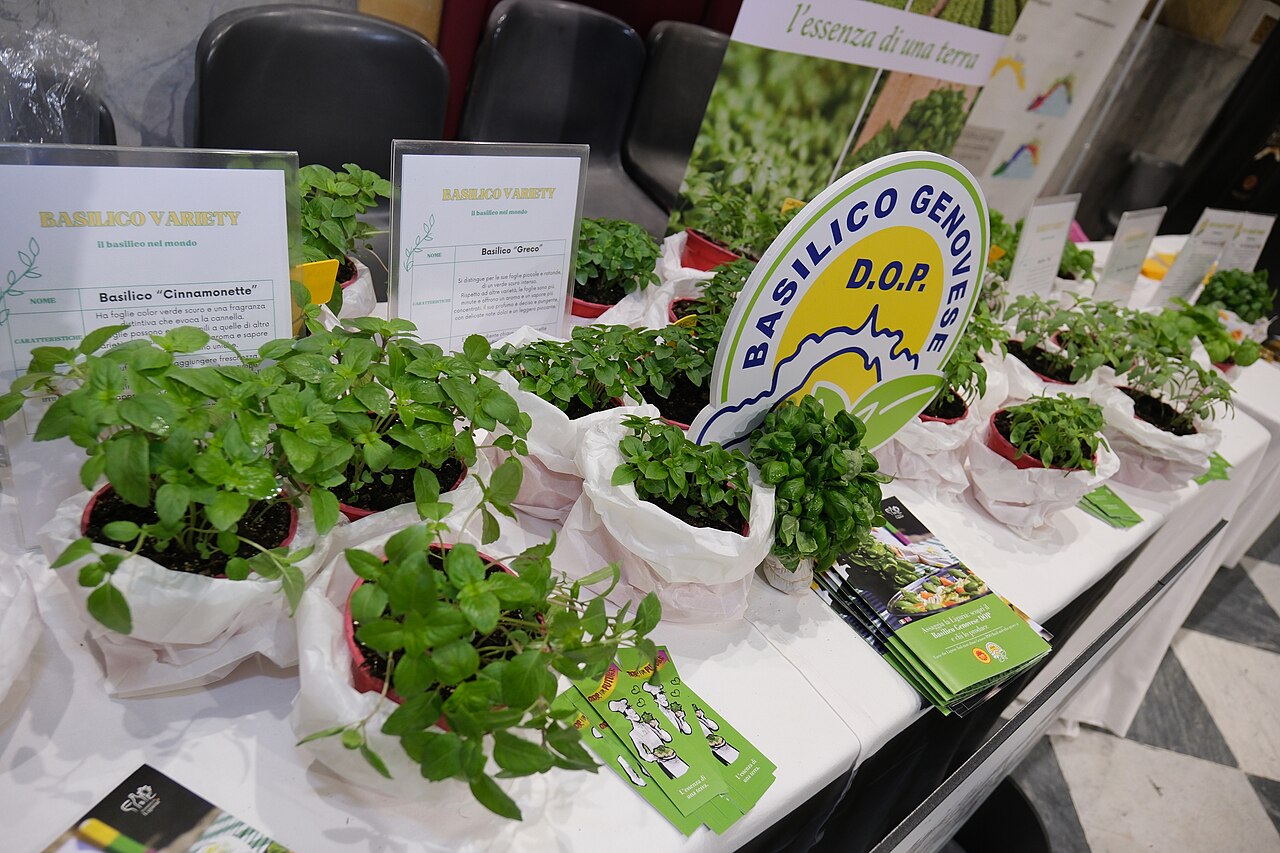
Genoese pesto has a clear regional reference point. Italy’s official tourism portal gives a recipe with Basilico Genovese DOP, extra-virgin olive oil, Parmigiano-Reggiano, Fiore Sardo pecorino, pine nuts, garlic and salt. Its quantities include two cloves of garlic for 50 g of basil—a useful reminder that strong garlic is not uniquely American. (Italia.it, “Pesto alla genovese”)
The protected designation Basilico Genovese DOP concerns where and how the basil is produced. Its permitted area extends along the maritime side of Liguria, rather than being confined to Genoa’s Pra’ district. The production rules require natural soil, including in protected cultivation. Growing a Genovese-type basil variety elsewhere does not give it that geographical designation. (Consorzio di Tutela Basilico Genovese DOP)
| Choice | Genoese reference | Options in this home-kitchen recipe |
|---|---|---|
| Basil | Basilico Genovese DOP, produced under the regional specification | Fresh sweet basil, including a home or indoor harvest |
| Nuts | Pine nuts in the cited recipe; optional walnuts in the pesto consortium’s specification | Pine nuts, walnuts or a mixture |
| Cheese | Parmigiano-Reggiano and Fiore Sardo in the cited regional recipe | Parmigiano-Reggiano with Fiore Sardo or Pecorino Romano |
| Preparation | Mortar and pestle are central to the tradition | Food processor, or a mortar for a small batch |
| Serving | Pasta, including the Ligurian combination with potatoes and green beans; also minestrone | Pasta, or a spoonful added to vegetables, soup or a sandwich |
These are choices for this recipe, within a much wider range of family practices. Variation also belongs to Liguria: the Consorzio del Pesto Genovese’s published specification includes optional walnuts, while Genoa’s Parco del Basilico recipe gives another cheese balance and loosens the sauce with the water used to cook pasta, potatoes and green beans.
A nineteenth-century recipe with room for substitution
The word pesto comes from pestare, to pound or crush—the work traditionally done with a pestle. (Treccani, “Pesto”) For the basil sauce’s printed history, a useful starting point is Giovanni Battista Ratto’s La Cuciniera Genovese, first published in 1863. Rome’s Museo della Cucina reproduces the early recipe and compares it with Emanuele Rossi’s 1865 version. (Museo della Cucina, “Ratto – Pesto alla genovese”)
Ratto’s recipe, as reproduced by the museum, combines garlic, basil, Dutch cheese and Parmesan, pounded and loosened with olive oil. It allows marjoram and parsley when basil is unavailable and adds hot water to help dress the pasta. Pine nuts do not appear in that reproduced text. The Dutch cheese is not identified there as a particular variety, so it is best to retain the cookbook’s wording.
Even this early printed version leaves room for the ingredients a cook can obtain. The modern Genoese reference recipe developed within a regional history; American adaptations belong to a later and more varied story.
Pesto’s American story
Italian migration carried many regional food traditions across the Atlantic. The Library of Congress records that more than four million Italians had arrived in the United States by 1920 and describes the poverty that drove migration from southern Italy and Sicily. Their food traditions were rooted in particular regions, towns and households. (Library of Congress, “The Great Arrival”)
A more specific record comes from the West Coast. In its own retrospective, Sunset identifies a recipe by the Tuscan-born writer and professor Angelo Pellegrini as the first pesto recipe it published, in 1946. The magazine describes an approach without exact quantities, followed by a more standardized recipe in 1959. Pellegrini’s The Unprejudiced Palate, first published in 1948, placed food within a wider life of gardening, wine and hospitality. (Amy Traverso, Sunset, 2008)
Pellegrini’s example brings the garden and the printed recipe into the same story. A sauce shared with magazine readers could travel far beyond a single household.
Later, Marcella Hazan helped American readers explore Italy’s regional cooking. The Smithsonian dates her first book, The Classic Italian Cook Book, to 1973 and identifies pesto among the ingredients and preparations she introduced through her teaching and books. Her work gives us another named person and a documented route through which culinary knowledge traveled. (National Museum of American History, 2024)
Kitchen equipment changed at the same time. Cuisinart records the American unveiling of its food processor in 1973. The appliance offered another way to make a sauce traditionally pounded by hand. Sunset’s later recollection places pesto’s wider popularity in the 1980s and 1990s, after these earlier recipes and books had reached American readers. (Cuisinart company chronology; Sunset)
The choices a family recipe preserves
Replacing pine nuts with walnuts changes the taste and texture of a batch. Choosing a different pecorino, adding butter, or using a machine can change it again. Those are meaningful kitchen choices. Assigning them to an entire diaspora requires evidence from recipes, cooks and communities.
That evidence can begin with a family recipe card or a short conversation. Ask who first made pesto in the household, where they learned it, which basil they grew and whether the recipe changed after a move. Write down the cook’s own quantities, including the adjustments they usually make by eye. If a detail is uncertain, keep that uncertainty with the story.
For a wider view, explore our guide to Italian American cuisine. To preserve a recipe’s personal history, visit the Digital Piazza for our family-story guide and an introduction to the Heritage Story Archive. The ingredients tell us how to make the sauce; the cook can tell us how it became part of the family’s table.